
It wasn’t a single, dramatic moment that made me notice her—it was the quiet ones. The moments most people hurry past without seeing.
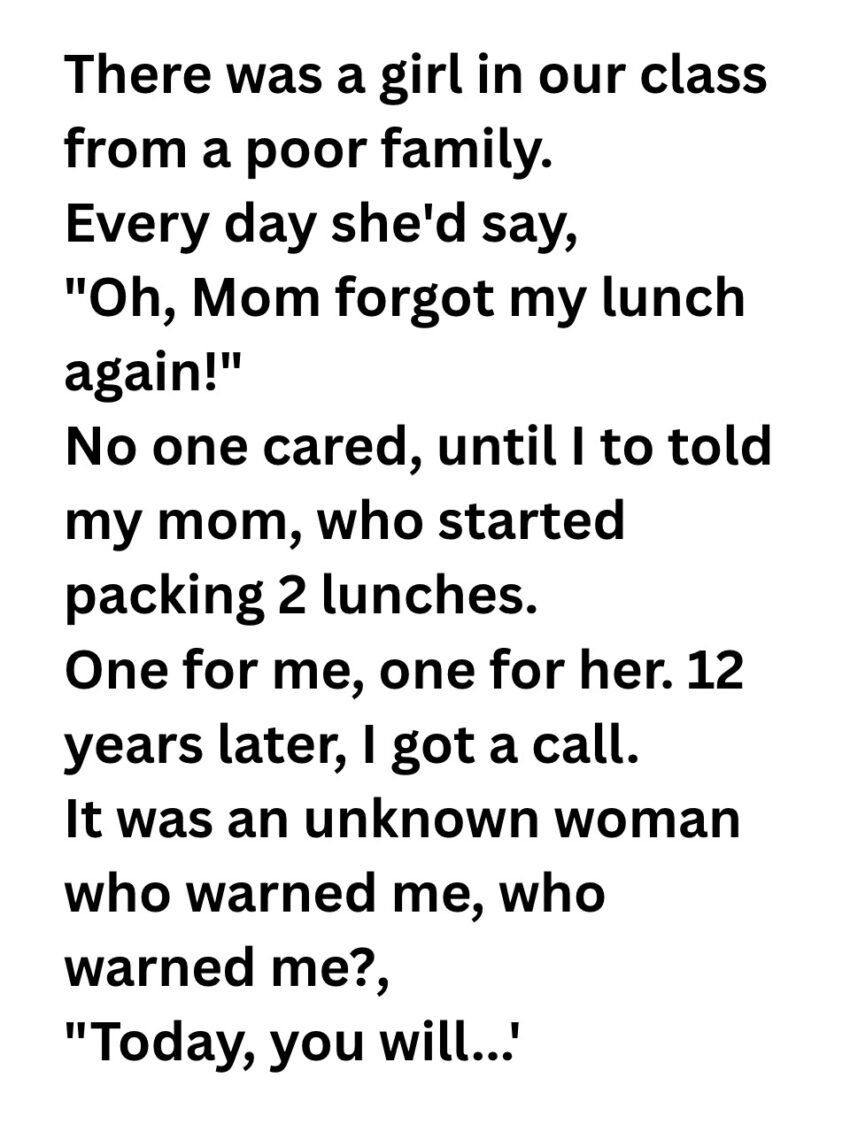
Every day at lunch, she sat at the far end of our cafeteria table. Her posture was always straight, her hands folded neatly in front of her, as if she was waiting for something that never came. Around her, the cafeteria buzzed with noise—rustling chip bags, laughter, the messy chaos of kids who didn’t know what silence felt like. But she sat still, calm, almost invisible.
There was never food in front of her. Not once.
No complaints. No sad looks. Just that tiny, brave smile she wore like armor—one that said she didn’t need anything, even though everyone could see she did.
When classmates asked if she’d forgotten her lunch, she’d laugh softly, like it was a little joke. “Mom must’ve skipped it again,” she’d say, as if it were nothing. But there was something in her voice—something too practiced for a child. It was the sound of someone who had learned not to expect much, who already knew that hoping could hurt.
One evening, while setting the table at home, I mentioned her to my mom. Not as a big story—just a passing comment. I told her about the girl who never had lunch, how she sat pretending she wasn’t hungry, how she never asked for help.
My mom didn’t interrupt. That was her way—she always listened completely, like every word mattered. When I finished, she touched the edge of the table, her fingers light against the wood, and said quietly, “Tomorrow, we’ll send two lunches.”
No lecture. No dramatic speech about kindness. Just that. She understood.
The next morning, she packed double of everything—two sandwiches, two pieces of fruit, two juice boxes—and tucked them into my backpack like it was the most natural thing in the world.
“You’ll know who to give it to,” she said, smiling.
At lunchtime, I sat beside the girl like always. My palms were sweaty, my throat dry. Funny how doing something kind can make you more nervous than doing something mean. I pulled out both lunches and placed one in front of her.
She froze. Her eyes went wide. Her hands hovered over the lunch like she wasn’t sure she was allowed to touch it. For a moment, I thought she might push it back.
But then she saw my smile—awkward but sincere—and something in her face softened. She whispered “Thank you,” so quietly that the cafeteria noise almost swallowed it whole.
But I heard it.
In that whisper, there was more than gratitude. There was relief. There was hope. There was the unspoken feeling of someone finally being seen after feeling invisible for too long.
That was the beginning.
From then on, we ate together every day. My mom never missed a morning. Some days she packed pasta or leftovers wrapped carefully in foil. Some days she added cookies or little notes with hearts drawn on them. She never asked for details. She just kept packing two of everything, trusting me to do what was right.
As the weeks went by, the girl began to talk more. Not a lot—she was still quiet—but enough for me to get glimpses of her world. Her mom worked two jobs. Rent was always late. Some nights, there simply wasn’t food to pack for school. But she never complained. Never blamed. She just accepted it with a calmness that didn’t belong to a child.
But something changed at that lunch table. She didn’t pretend anymore. She didn’t hide behind her smile. She let herself be present, allowed herself to belong. The seat next to me became hers by default, and those lunches became a kind of ritual—a small, safe space where the world felt a little gentler for both of us.
Then childhood ended, as it always does. We went to different schools. Different lives. Over time, she faded into memory—a warm, quiet memory tucked somewhere in the back of my mind.
Years passed.
Then one afternoon, my phone rang. The number was unfamiliar. I almost ignored it. But something made me answer.
A voice said, “You might not remember me… but I’ll never forget you.”
It was her.
For a moment, I couldn’t speak. It felt surreal, hearing the grown-up version of the girl who once sat beside me with an empty table in front of her. Her voice still had that softness, but now there was strength in it—like life had shaped her, but hadn’t broken her.
She told me she’d found my number through a mutual friend. “I’ve been wanting to call you for a long time,” she said. “Those lunches… they meant everything to me. Not just the food. The fact that you saw me.”
I sat there with tears in my eyes. I had never realized how deeply those small acts had reached her. To me, it was simple—she was hungry, and my mom and I had food to share. But to her, it had been proof that she wasn’t invisible. Proof that someone noticed.
Then she said something that made my breath catch.
“Every week,” she said, “I donate lunches to kids at a local shelter. I always think of you and your mom when I do. You showed me what kindness really looks like.”
We talked for a long time that night. She told me about her life—how she’d finished school, gotten a job, built a life she was proud of. She talked about the community meal program she was starting, one that would feed children and families who needed help, no questions asked.
When I told her about my mom, she laughed softly. I said she still packed too much food for every trip, still sent leftovers home with anyone who visited, still believed that feeding people was her way of showing love.
Before we hung up, she asked me to pass along a message: “Tell your mom that her kindness didn’t stop with me. It grew.”
That line stayed with me for days. When I told my mom later, she paused, smiled that quiet, knowing smile of hers, and said, “That’s how kindness works. It doesn’t stay where you put it. It keeps moving.”
And she was right.
Those lunches weren’t grand gestures. They weren’t charity or pity. They were small, steady acts of care—simple, human, honest. And those are the acts that last the longest.
People think kindness has to fix everything to matter. It doesn’t. Sometimes it’s just about helping someone get through one hard day. Sometimes it’s just a sandwich, a seat at a table, a quiet “I see you.” But that can be enough to change someone’s story.
Even now, when I pack an extra meal or donate to a food drive, I think of her. I think of that little girl sitting at the end of the cafeteria table, pretending she wasn’t hungry. I think about how something as small as sharing lunch turned into something that rippled outward—across years, across people, across lives.
Because kindness doesn’t end. It travels. It grows. It multiplies in ways you might never see. It moves through hands and hearts, from one act to another, until one day it circles back.
And sometimes, it returns in the voice of someone saying, softly but surely, “Thank you for seeing me.”
That’s what I carry with me now. Not guilt, not pride—just a deep understanding that the smallest moments can echo the loudest.
It started with one quiet girl, one caring mother, and two lunches.
But what grew from that was something much bigger—a reminder that the simplest acts of care can outlast time, distance, and even memory. Because real kindness doesn’t just feed hunger. It feeds hope.
And hope, once shared, never really disappears. It just finds new hands to hold it, new hearts to carry it forward, and new lives to change.