
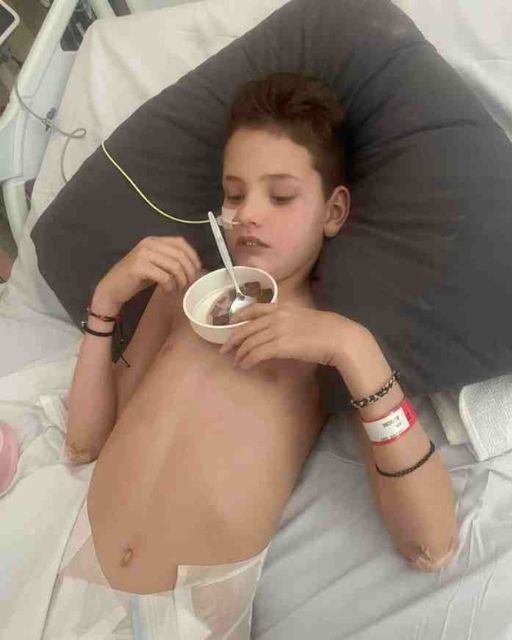
I took that photo on day eleven.
We hadn’t slept. We hadn’t smiled. We hadn’t heard the word “diagnosis” once, just a rotating carousel of specialists who kept saying the same infuriating phrase: “Let’s run a few more tests.”
It started with nausea. Then vomiting. Then he just stopped eating altogether. One minute he was running in the backyard with a popsicle, the next he couldn’t lift his head without crying out in pain.
But the worst part?
He stopped talking.
No complaints. No “Mom, it hurts.” Just this eerie silence and that blank stare like his spirit was already halfway out of his body.
I begged for answers. I snapped at nurses. I even Googled things I had no business Googling—rare diseases, metabolic conditions, brain inflammation.
And then came the day when I heard the words I feared the most.
It was late afternoon, and the hospital room felt colder than usual. The fluorescent lights buzzed above, casting a harsh, artificial glow on everything around us. My son, Ethan, was lying still on the bed, his tiny body pale and fragile beneath the hospital gown. His chest rose and fell with shallow breaths, but there was no life in his eyes.
I sat beside him, holding his small hand in mine. I had been doing that for days, hoping that somehow, some way, the touch of a mother’s love would wake him up from whatever nightmare he was trapped in.
The door opened, and Dr. Matthews, a kind-faced neurologist who had been assigned to us that day, walked in with his clipboard. He was one of the few doctors who had looked me in the eye when speaking, and I could tell he genuinely wanted to help. But even he didn’t have an answer for me.
He looked at Ethan, then back at me. “We’ve ruled out some of the more immediate causes,” he said, his voice calm but laced with an undercurrent of uncertainty. “But we still don’t have a clear diagnosis. It could be something viral, a lingering infection, but—” He paused, glancing down at his notes. “It’s not adding up.”
I clenched my fists under the table, the anxiety rising inside me again. “But what is it?” I almost yelled, my voice cracking. “My son’s not getting better. He’s getting worse.”
Dr. Matthews sighed, setting the clipboard down and sitting on the edge of the bed. “We’ll keep testing, and I promise we’re doing everything we can. But sometimes, these things take time. It could just be a stomach bug, a viral infection that’s running its course. We’ve seen it before.”
Just a stomach bug.
I stared at him, the words echoing in my mind like a hollow promise. I didn’t believe him. Ethan wasn’t getting better; he was fading.
“Can we… can we talk to someone else? Another specialist? A second opinion?” My voice was soft now, barely above a whisper. I didn’t want to sound desperate, but I couldn’t help it. I was desperate.
Dr. Matthews hesitated, and I could see the exhaustion in his eyes. He’d been working long hours, just like everyone else in the hospital. But the look he gave me was one of sympathy, not certainty. “Of course, we can get you a second opinion. But I want to remind you that it’s crucial we stay focused on the facts, not assumptions.”
I nodded, though every fiber of my being screamed in defiance. Facts. The fact was, my son wasn’t eating. He couldn’t keep water down. His body was slowly giving up, and no one had the answers I needed.
That night, I stayed awake by his bedside, my eyes glued to his pale face. He was still. Too still. And I couldn’t stop the nagging voice in the back of my mind telling me that this was not just a stomach bug.
It was around 2 a.m. when I heard the soft click of the door opening. I was about to look up when I felt a gentle hand on my shoulder. I turned and saw Dr. Matthews standing there, looking more serious than I’d seen him all day.
“I… I just got the results back from a more comprehensive test,” he said quietly. “It’s not what I expected, but it’s something we need to discuss.”
I immediately felt a rush of cold fear sweep through me. “What is it?” I whispered, the words barely making it past my throat.