
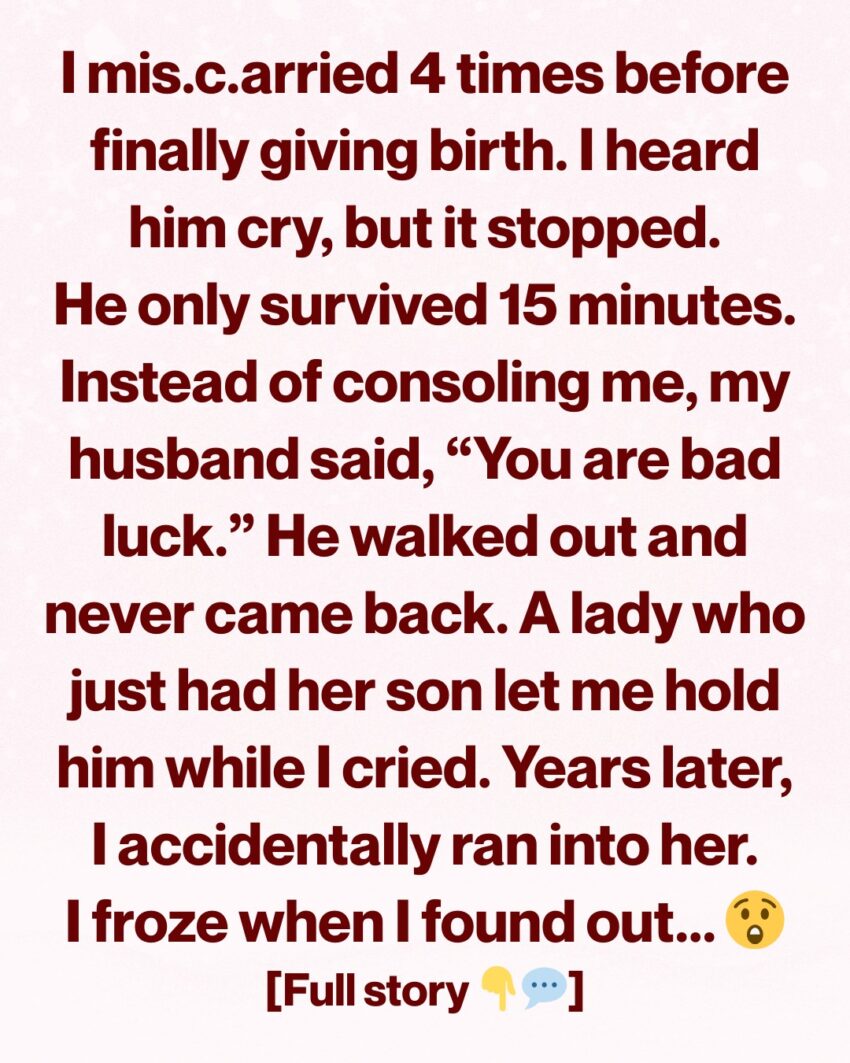

I had mis:carried four times before that night. Four times of hope rising carefully, like glass held in trembling hands, and four times of it shattering. By the time I became pregnant again, I had trained myself not to dream too loudly. I didn’t buy baby clothes. I didn’t choose a name. I moved through the months cautiously, as if joy itself might tempt fate.
The labor was long and exhausting. When the baby finally came, I was so tired I could barely lift my head. Then I heard it—a cry. Just one. Thin, fragile, but real. In that moment, everything else disappeared. The years of loss, the fear, the restraint—I thought, He’s here. He’s alive.
And then the room went quiet.
Nurses moved faster. Voices lowered. Someone adjusted a monitor, then turned it off. Fifteen minutes. That was all my son had in this world. Fifteen minutes, and he was gone.
I lay there shaking, staring at the ceiling, unable to scream or cry. My body felt hollow, like it had already begun forgetting what it was made for. I didn’t even notice when my husband stepped closer, not until his shadow fell across the bed.
He looked at me—not with grief, not with confusion, but with something sharp and cold.
“You are bad luck,” he said.
The words landed heavier than any diagnosis, any doctor’s explanation. As if my body had chosen this. As if I had failed on purpose.
He didn’t wait for a response. He turned and walked out of the room. Out of my life. He never came back.
I stayed there long after visiting hours ended, numb, staring at the wall as if it might eventually explain how everything had fallen apart so completely. That was when I heard a soft voice from the bed beside mine.

“Excuse me,” the woman whispered to the nurse. “Could she… could she hold my baby for a moment?”
I turned my head, startled. She didn’t know me. She didn’t know my story. She hadn’t seen the way my husband left or the way my hands were still shaking. But she looked at me with a gentleness that made my chest ache.
The nurse hesitated, then nodded.
They placed the newborn in my arms, warm and breathing, wrapped in a tiny blanket. I broke then. I cried silently, my tears soaking into that fabric, my face pressed close enough to feel life pulsing where mine had stopped. The mother watched me, her eyes full but calm, as if she understood that this was not about loss stealing joy, but about sharing it.
She trusted me with her baby while I fell apart. That moment stitched something back together inside me.
Years passed. I rebuilt my life slowly, carefully. I learned how to breathe without expecting pain to follow. One afternoon, in a grocery store of all places, I saw her.
She was older, like me. Her child stood beside her, laughing, very much alive. Our eyes met, and we both froze. Then she smiled.
“I know you,” she said softly.
We talked right there between the shelves. She remembered that night. She remembered me.
And then she told me something I never knew.

She told me that after I was wheeled away, she had seen my husband in the hallway. She had confronted him—told him exactly what kind of man walks away from a woman who just lost a child, what kind of cruelty hides behind blame. She said she didn’t raise her voice, but she didn’t hold back either.
A few days later, my phone had rung. My husband apologized. Now I knew why.
I never took him back. I never even considered it. Some words can’t be unsaid.
But standing there in that grocery store, listening to her, I felt something warm settle in my chest.
I wasn’t alone back then. Someone had taken my side.
And all these years later, I was still grateful.
Note: This story is a work of fiction inspired by real events. Names, characters, and details have been altered. Any resemblance is coincidental. The author and publisher disclaim accuracy, liability, and responsibility for interpretations or reliance. All images are for illustration purposes only.