
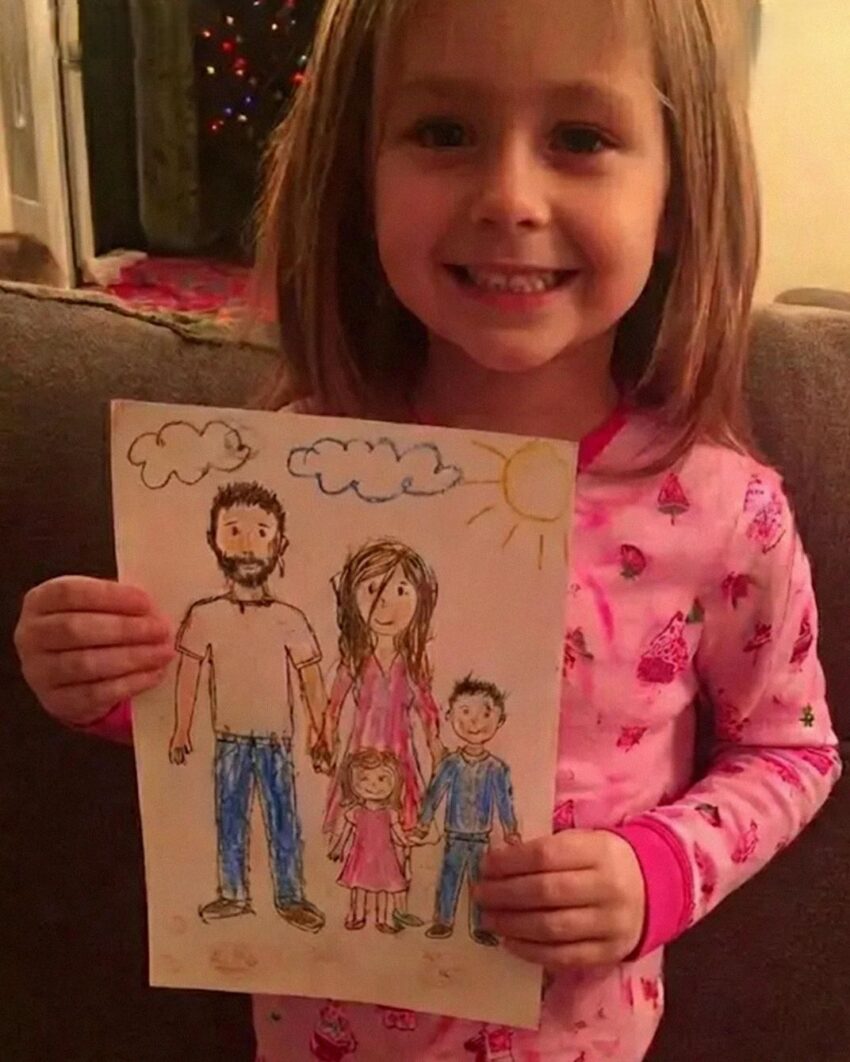
In the vibrant, chaotic world of parenting a five-year-old, milestones are often marked by refrigerator art. For Linda, a thirty-six-year-old mother, her daughter Anna’s drawings were the joyful wallpaper of their lives—stick-figure chronicles of trips to the park, imaginary castles, and the “sparkle monster” antics of her husband, Mark. Their life in a quiet suburban pocket felt curated for comfort, a sanctuary of glitter and bedtime stories. However, the air was sucked out of that sanctuary when a simple kindergarten assignment—”Draw your family”—morphed from a childhood rite of passage into a devastating forensic clue.
The drawing seemed innocent at a glance: a cheerful tableau of bold primary colors. There was Linda, recognizable by her signature smile; Mark, tall and waving; and Anna in the center, her pigtails rendered like curious antennae. But it was the fourth figure that caused Linda’s heart to stumble. Standing beside Anna, holding her hand with an easy, practiced familiarity, was a boy. He was drawn with the same intentionality as the rest of the family, smiling as if he had always occupied that space on the page.
When Linda gently probed, assuming the figure was a school friend or an imaginary playmate, the light in Anna’s eyes vanished, replaced by a gravity no five-year-old should possess. The child clutched the paper to her chest, her voice dropping to a fragile whisper that carried the weight of a forbidden secret. “Daddy said… you’re not supposed to know,” Anna murmured. The chill that crawled up Linda’s spine was instantaneous. When the child finally blurted out that the boy was her brother and would be living with them soon, the domestic silence of the kitchen became suffocating. Anna bolted to her room, leaving Linda standing in the hum of the refrigerator, her world cracking open beneath her feet.
The ensuing night was a hollow exercise in endurance. As Mark slept with the deep, rhythmic breathing of a man with a clear conscience, Linda lay staring at the ceiling, replaying her daughter’s words. The betrayal felt like a living thing in the room. By morning, Linda had transformed her grief into a cold, clinical determination. She performed the familiar rituals of the morning—straightening Mark’s tie, braiding Anna’s hair—with a masked precision. The moment the house was empty, she began a systematic search for the truth.
The evidence was tucked away in the shadows of their shared life. In Mark’s office, buried beneath mundane tax returns and insurance folders, Linda found an envelope from a children’s clinic. The medical bill inside was for a seven-year-old boy whose name she didn’t recognize. In the back of a closet, hidden behind a briefcase, she discovered a shopping bag filled with clothes—dinosaur T-shirts and sneakers that were far too large for Anna. Each discovery was a physical blow: receipts for kindergarten fees across town, toys from unfamiliar stores, and grocery slips for food their household never consumed. By the time Mark returned home that evening, the dining room table had been transformed into an altar of evidence, with Anna’s drawing sitting at the center like a silent witness.
The confrontation was stripped of theatrics, replaced by the heavy, jagged edge of a shattered trust. Mark’s defense was not a denial of the child, but a denial of infidelity. He sank into a chair, his face drained of color, and confessed to a past he thought had been buried seven years prior. Before meeting Linda, he had been with a woman named Sarah. They had parted ways, and she had never informed him of her pregnancy. He had remained oblivious to the existence of his son, Noah, until a few months ago, when a medical crisis forced Sarah’s hand. Noah was ill and needed a blood transfusion; out of desperation, she had sought out the biological father.
The logic of the secret was rooted in fear—a cowardice that Mark framed as protection. He had been terrified that the sudden appearance of a seven-year-old son would incinerate his marriage, so he chose to lead a double life. He supported the boy, visited him during his recovery, and even introduced him to Anna during their “trips to the park,” all while keeping Linda in a vacuum of ignorance. He handled the situation with a catastrophic lack of judgment, letting a five-year-old carry the burden of the truth before his own wife.
The weeks that followed were a grueling navigation of emotional wreckage. There were explosive arguments that bled into the early morning hours and long stretches of silence that felt like a permanent frost. Trust, Linda realized, is not a singular thing that breaks and is mended; it is a thousand tiny threads that must be rewoven one by one. Yet, amidst the fury and the heartbreak, the reality of Noah remained. He was an innocent child caught in the crossfire of adult deception and biological chance.
The turning point arrived not through a grand apology, but through the eyes of her daughter. When Linda finally agreed to meet Noah, she was braced for a struggle, her stomach knotted with a resentment she couldn’t quite shake. But when she saw the boy—small, shy, and clinging to Mark’s hand with the same dimple that graced Anna’s face—the anger shifted. He wasn’t a threat to her family; he was a fragile addition to it. Before Linda could even speak, Anna let out a squeal of “My brother!” and threw her arms around him. The transformation on Noah’s face, a transition from uncertainty to a radiant, belonging smile, gutted Linda’s remaining defenses.
Slowly, the household began to expand. The living room floor became a permanent landscape of Lego towers and shared picture books. The quiet of the house was replaced by the chaotic, beautiful harmony of two giggles instead of one. Noah began to spend regular weekends with them, carving out a space for himself in the pigtails and glitter monster world. While the sting of Mark’s initial secret remained a dull ache in the background of their marriage, the joy Noah brought into their lives became an undeniable force of healing.
It was a family redefined—not the one Linda had envisioned, and certainly not the one she would have chosen under these circumstances, but a family nonetheless. One evening, as Linda tucked both children into their blankets, the house felt finally, tentatively, at peace. She leaned down to kiss Anna’s forehead, and the little girl whispered a final, chillingly beautiful secret: “See, Mommy? I told you he was coming to live with us.”
When Linda asked who had told her such a thing before they had even met, Anna’s eyes fluttered shut, her voice drifting off into the threshold of sleep. “My brother did,” she murmured. In the quiet of the room, Linda realized that children often see the shape of a family long before the adults have the courage to build it. The drawing on the fridge was no longer a mystery; it was a blueprint for a life that was larger, more complicated, and ultimately more full of love than she had ever imagined.